Velvet Revolution in Bratislava: Places Where Freedom Found Its Voice
How did Bratislava experience the fall of communism in 1989? Follow the footsteps of students, dissidents and ordinary citizens through the places that witnessed one of the most important moments in modern Slovak history.
The Velvet Revolution of November 1989 was a turning point in the history of Czechoslovakia. After more than four decades of communist rule, people finally took to the streets to demand freedom, democracy and an end to the one-party system.
While Prague often receives most of the international attention when talking about the Velvet Revolution, Bratislava also played an important role. In fact, Slovak students took to the streets already on November 16, 1989 – one day before the famous student demonstration in Prague.
What followed was a remarkable wave of peaceful protests that brought together students, artists, workers and ordinary citizens. People who had spent decades living under an authoritarian regime suddenly discovered the power of standing together.
Today, many places in Bratislava still carry traces of these events. Some are marked by memorial plaques, others look just like ordinary city squares. But behind their everyday appearance lies a story worth discovering.
Let’s take a closer look at the places where Bratislava’s Velvet Revolution unfolded.

1. Hodža Square – Where the Student Protests Began
The story of the Velvet Revolution in Bratislava began on November 16, 1989, at what is now Hodža Square, in front of the Presidential Palace.
Around 200–250 university students gathered here for an unauthorised demonstration against the communist regime. Their original demands included greater academic freedom, educational reforms and the right to express their opinions without fear of persecution.
Holding hands, singing and chanting slogans, the students formed a procession and headed towards the city centre.
At that time, organising a public protest without official permission was a risky decision. Participants could face interrogation, punishment or even expulsion from university.
Nevertheless, the students continued their march. Their demonstration became an important prologue to the events that would transform Czechoslovakia just a few days later.
Today, the square is dominated by the Presidential Palace. It is hard to imagine that this peaceful-looking location was once the starting point of a protest that challenged an entire political system.

2. SNP Square – The Heart of the Velvet Revolution
If there is one place in Bratislava that symbolises the Velvet Revolution, it is undoubtedly SNP Square.
From November 22, 1989, the square became the main gathering point for mass demonstrations against communist rule. Tens of thousands of people came here to listen to speeches, express their opinions and demand political change.
The atmosphere was extraordinary. People of different ages, professions and backgrounds stood shoulder to shoulder, united by a common desire for freedom.
One of the most recognisable symbols of the revolution was the sound of keys being jingled in the air. This simple gesture became a symbolic farewell to the communist regime.
The square also hosted speeches by representatives of the newly emerging civic movement Public Against Violence (Verejnosť proti násiliu – VPN), as well as prominent personalities such as Alexander Dubček and Czech singer Karel Kryl.
Today, a memorial plaque on the facade of the hospital at SNP Square commemorates the events of November 1989. Above it, you can spot the characteristic letter V – the symbol of Public Against Violence.
The lower part of the square is now officially known as Námestie Nežnej revolúcie (Velvet Revolution Square).
It is worth stopping here for a moment and imagining the atmosphere of those November days. The square may look ordinary today, but it once became the stage for a historic transformation of Slovak society.

3. Hviezdoslav Square – A Meeting Place for Freedom
Another important location connected to the revolution is Hviezdoslav Square, one of Bratislava’s most beautiful public spaces.
The square was already familiar to protesters from an earlier demonstration – the Candle Demonstration of March 25, 1988. This peaceful gathering, organised by religious and civic activists, demanded religious freedom and respect for human rights. It was violently dispersed by the communist police.
During the student march on November 16, 1989, the protesters stopped here to commemorate the Candle Demonstration and its participants.
A few days later, Hviezdoslav Square became another important gathering place for students and citizens supporting the growing protest movement.
Meetings here were not only about political demands. They were also about solidarity, courage and the feeling that society was finally beginning to change.
Today, the square is known for its cafés, restaurants, historic architecture and the building of the Slovak National Theatre. It is one of the busiest pedestrian areas in the Old Town.
Yet, beneath its pleasant atmosphere lies a much more serious chapter of Bratislava’s recent history.
4. Comenius University – Students Who Refused to Stay Silent
The Velvet Revolution would hardly have been possible without the involvement of students.
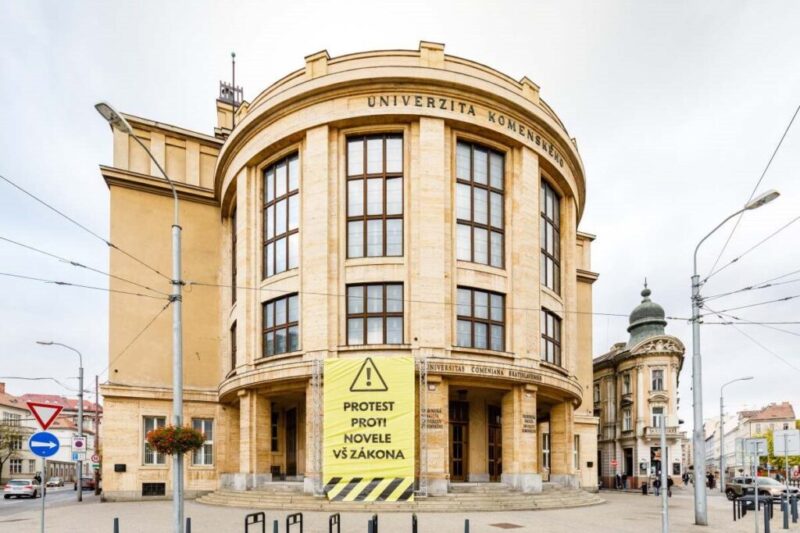
Comenius University, Slovakia’s oldest university, played an important role in the events of November 1989. Its students were among the first to openly challenge the communist regime in Bratislava.
On November 16, the student procession made its way through the city towards the university buildings. The demonstration continued the following days, with students organising meetings, discussions and protests.
On November 21, thousands of students gathered in front of the university at Šafárik Square and at Hviezdoslav Square. Their demands went far beyond university reforms. They called for political change, freedom of speech and respect for human rights.
A memorial plaque on the university building commemorates Danka Košanová, who was shot dead by occupying Soviet forces during the invasion of Czechoslovakia in August 1968. Her story is another reminder of the difficult history that shaped the generation of students who protested in 1989.
Standing in front of the university today, it is worth remembering that many of the people who helped bring down the communist regime were young students who simply refused to accept that things could never change.

5. Freedom Square – From Communist Symbol to Memorial of Democracy
Freedom Square has a particularly symbolic connection to the political transformation of 1989.
During the communist era, the square was known as Gottwald Square, named after Klement Gottwald, the first communist president of Czechoslovakia. A monumental statue of Gottwald once dominated the space, representing the power and ideology of the regime.
During the Velvet Revolution, the square became an important location for public gatherings, especially for the student movement.
After the fall of communism, Gottwald’s statue was removed in 1990. The square gradually regained its original name – Freedom Square.
In November 2025, a new Memorial of November 1989 was unveiled here, commemorating the people who stood up against totalitarianism. Its design features 407 bronze footprints, symbolising individuals who took a step towards freedom.
The transformation of this square is particularly meaningful. A place once dominated by a monument to a communist leader now honours ordinary people and their courage.
It is a good example of how public spaces can change their meaning along with society itself.

A Revolution That Changed More Than Politics
The Velvet Revolution was not won by politicians alone. It was made possible by ordinary people who decided that fear should no longer determine their lives.
Students, workers, artists, intellectuals and families filled the streets of Bratislava and other Slovak cities. They demanded freedom without resorting to violence.
On December 10, 1989, President Gustáv Husák appointed a government in which non-communist politicians held the majority and subsequently resigned. The communist monopoly on political power was coming to an end.
The events of November 1989 opened the way for democratic transformation and, eventually, the establishment of an independent Slovak Republic in 1993.
More than three decades later, Bratislava has changed considerably. New buildings have appeared, old industrial areas have been transformed and the city has become a popular destination for international visitors.
But the places connected to the Velvet Revolution are still here.
Some have memorial plaques, others have been given new names or monuments. Many look completely ordinary, which makes their stories even more interesting.
Walking through Bratislava with these events in mind offers a different perspective on the city. Beyond the medieval Old Town and the familiar tourist attractions, there is another layer of history – one that explains how Slovakia became the country it is today.
Freedom is often taken for granted by those who have never had to fight for it. The places of the Velvet Revolution remind us that it was not always a given.
And perhaps that is the most important reason to remember November 1989.